Dialogue · CreatorSonicWhat Audio Restoration Can and Can't Fix
Hum, clicks, clipping, wind and dropouts. An honest guide to which audio problems an engineer can repair, which ones they can't, and how to tell.
By The Richmond Studios5 min read
“Can you save this recording?” is one of the questions we hear most often. Sometimes it is an interview that picked up a buzzing light. Sometimes it is a family cassette, a wind-battered location take or a podcast episode where the microphone clipped every time the guest laughed.
The honest answer is usually “yes, a lot of it”, followed by “but not all of it”. Audio restoration is powerful, but it is not magic. Knowing what it can and can’t do helps you decide whether a recording is worth sending, and what to do differently next time.
What restoration means
Audio restoration is the work of removing or reducing damage from a recording while keeping the sound you actually want. That damage might come from the room, the equipment, the weather, the tape or the way the file was handled.
At The Richmond Studios, restoration is done by engineers, listening closely and making each decision by ear. We don’t use AI to edit our clients’ audio. Tools help us find and treat problems, but a person decides how far to go, because the same fix that rescues one sentence can damage the next.
Problems we can usually fix well
Hum and buzz
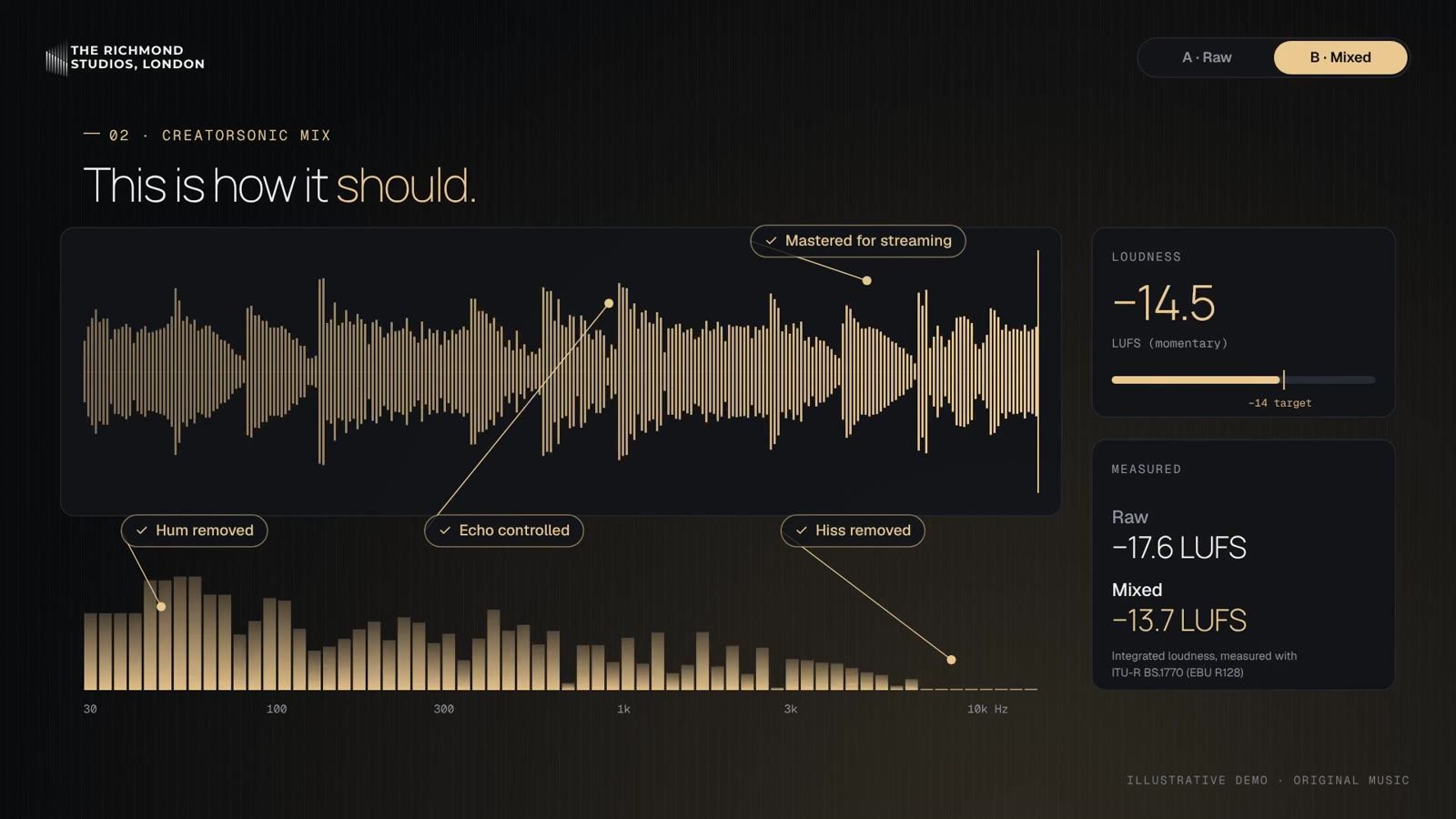
Mains hum, ground loops and the whine from lights or chargers are steady and predictable, which makes them some of the easiest problems to reduce. Often they can be removed almost completely without touching the voice.
Hiss and steady background noise
Tape hiss, air conditioning, computer fans and distant traffic can be reduced a long way. The key word is reduced. Push noise reduction too hard and voices start to sound watery or metallic, so the aim is a background that stops being distracting, not one that is perfectly silent.
Clicks, crackle and mouth noise
Vinyl crackle, digital clicks, lip smacks and the odd chair creak are short events, so they can be repaired one by one. On old records and tapes this can transform a recording.
Mild clipping
When a recording overloads, the tops of the waveform are cut off and the sound distorts. If it only happens on a few peaks, those peaks can often be rebuilt so the distortion is much less noticeable.
Some room echo
A voice recorded in a bare room can be made to sound closer and drier. Light to moderate echo responds well. If you are recording at home, our guide on how to reduce room echo when recording a podcast will save you most of this work.
Problems we can improve, but not erase
Wind noise
Wind hitting an unprotected microphone produces low, heavy rumbles that overlap with the voice. Gentle gusts can be cleaned up well. Strong, constant wind can be reduced, but the voice underneath may never sound fully natural.
Heavy clipping
If a whole recording was too hot, with distortion on almost every word, repair can make it easier to listen to, but some harshness will usually remain.
Noise that sounds like the voice
Background chatter, a television, music with vocals or a second person talking over the speaker sit in the same range as the voice you want to keep. Separating them is slow, careful work, and the result depends heavily on how loud the unwanted sound is.
Very reverberant spaces
Churches, stairwells and large halls can be tamed, but you can’t fully turn a cathedral into a vocal booth. In a film, this is often the point where ADR becomes the better option.
Problems restoration can’t fix
Some things are simply not in the recording to be recovered:
- Words that were never captured. If a line was covered by a door slam or lost in a dropout, it can’t be brought back. It may be possible to patch it from another take.
- Heavily compressed files. A low-quality export or a voice note sent through a messaging app has already thrown detail away. Always ask for the original file.
- A microphone in the wrong place. If the speaker was across the room from the mic, the recording is mostly room. Cleaning helps, but it won’t sound close.
- Damage baked into an old copy. If a tape was copied several times before it reached you, each generation added noise. Finding the earliest copy helps more than any process.
How to give your recording the best chance
If you have a recording that needs help, a few things make a real difference:
- Send the original. The file straight from the recorder, camera or phone, not an edited or re-exported version.
- Send every source. If you recorded on a lav and a camera mic, send both. One may be cleaner in the moment the other fails.
- Tell us what matters. Is it the whole recording, or one key interview answer? Restoration time goes where it counts.
- Include room tone if you have it. A few seconds of the room with nobody talking gives the engineer a clean sample of the noise to work from.
- Stop recording over damage. If a tape is fragile or a card is corrupting, don’t keep using it. Copy it as it is and stop there.
Restoration for creators, film and archive
Restoration is part of our wider audio post-production work for film, broadcast and archive material, and it is built into CreatorSonic, our service for YouTubers, podcasters and social creators. CreatorSonic covers clean-up and fixing alongside platform-ready mixing, sound effects, and intros and jingles, with your files shared in an NDA-protected folder. If you would like to see the dialogue side in more detail, read what happens when an engineer cleans up your dialogue.
If you have a recording you are not sure can be saved, get in touch and an engineer will listen and tell you honestly what is possible.
Quick answers
What audio problems can restoration fix?
Hum and buzz can often be removed almost completely. Hiss and steady background noise can be reduced a long way, clicks, crackle and mouth noise can be repaired one by one, mild clipping can often be rebuilt, and light to moderate room echo responds well.
What can't audio restoration fix?
It cannot recover words that were never captured, for example under a door slam or in a dropout, or detail already thrown away by heavily compressed files such as voice notes sent through messaging apps. Strong wind, heavy clipping and very reverberant spaces can be improved but not erased.
Is audio restoration at The Richmond Studios done by AI?
No. Restoration is done by engineers listening closely and making each decision by ear. Tools help find and treat problems, but a person decides how far to go, because the same fix that rescues one sentence can damage the next.